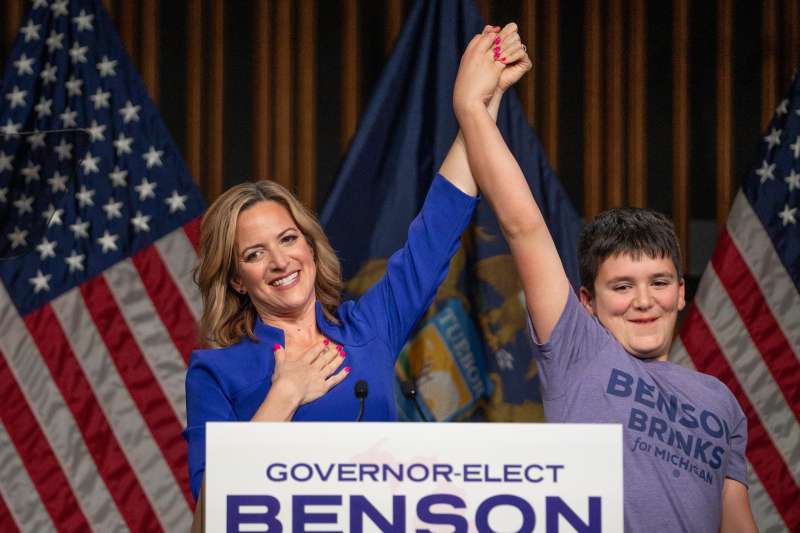
With Michigan Gov.-elect Jocelyn Benson flanked by the biggest Democratic legislative majorities in decades, state Democrats say they see a huge mandate, and promise transformation.
Benson’s win against her Republican rival US Rep. John James of Shelby Township, marks the first time since 1960 that Michigan voters have replaced the outgoing governor with a leader from the same party. Not only did Democrats retain control of the Michigan Senate, they expanded their majority. And they also managed to wrest control of the Michigan House of Representatives from Republicans.
Candidates from both parties promised to make life more affordable in their campaigns, but election results indicate that voters trusted Democrats more to tackle cost-of-living challenges.
“Voters in Michigan spoke loud and clear. They want leaders who will work together to lower their costs and grow the economy. That is my focus, as well as improving our public schools,” Benson told reporters at a Nov. 4 news conference.
Michigan Democratic Party Chair Curtis Hertel said Democrats “have a majority that can get big things done for people and make Michigan a place where people can afford to raise a family again, which I think is the most important thing.”
The last Democratic trifecta won in 2022 was the first in 40 years. They moved quickly to pass Democratic priorities opposed by Republicans that had stalled from years: They repealed the state’s right-to-work law, established new gun regulations, expanded reproductive rights and more.
But infighting during their final days in power killed many Democratic bills.
However, Democrats say they are more prepared to be in power this time.
“It’s night and day the level of preparation as compared to four years ago,” said Abby Clark, a longtime Democratic operative and the Michigan Director of Government Affairs for the Natural Resources Defense Council.
House Republicans’ communications director Gideon D’Assandro did not immediately provide comment from Michigan House Speaker Matt Hall, R-Richland Township, on how Republicans would work with Democrats in the next legislative session.
The Democratic agenda will take shape in the days, weeks and months to come. But some things already have been made clear by their policy priorities.
A Michigan Voting Rights Act
Before her win, Benson said she expects a flurry of legislation to be introduced at the start of the next session. She wouldn’t say which bill should be introduced first, but Michigan’s chief elections officer said she has her eye on her inaugural bill signing.
After she kicked off a final canvassing push for state Sen. Kevin Hertel’s, D-St. Clair Shores, competitive race Oct. 30, she told reporters “…the first bill I will sign is a Voting Rights Act for the state of Michigan to restore the protections that were gutted by the US Supreme Court when they eliminated a lot of the strength of the National Voting Rights Act earlier this year.”
Data centers
The energy- and water-intensive facilities powering the artificial intelligence boom have drawn the ire of Democrats and Republicans alike. Lawmakers from both parties have introduced proposals for data center regulations and a moratorium. Benson promised to pursue data center guardrails during her campaign.
State Sen. Mallory McMorrow, D-Royal Oak, who won’t serve in the next Michigan Legislature, said Senate Democrats’ plan “would be the strongest data center regulation in the country” that would guarantee residential energy costs don’t increase, require community benefits agreements and ensure “that we are not left holding the bag in case one of these companies goes under.”
McMorrow told reporters at the Democrats’ election night party in Detroit Nov. 3 that “because it’s sitting there, it should be one of the very first things that gets done.”
Lowering costs
In addition to data centers, Democrats and Republicans have promised to lower energy costs.
“The state Legislature can’t stop the war in Iran or open the straight of Hormuz,” said Clark. “But there are things they can do, absolutely.” She mentioned accountability measures for utility providers and water affordability legislation that has previously been introduced.
Danielle Atkinson, the founder and executive director of Mothering Justice, said lawmakers should prioritize lowering child care costs and establishing paid family and medical leave, a proposal that died in the last Democratic trifecta.
Abortion and gun safety
When Democrats won power in 2022, Michigan voters passed a ballot measure to guarantee a right to abortion in Michigan after the US Supreme Court overturned Roe v. Wade.
Whitmer went on to repeal many antiquated abortion restrictions when Democrats last had legislative majorities, but some were left in place.
For instance, while the governor called on lawmakers to repeal Michigan’s 24-hour waiting period for those seeking abortions, state Rep. Karen Whitsett of Detroit, who caucused with Democrats at the time, stood in opposition, derailing the legislation.
“One of my top priorities is going to be working on the mandatory waiting period for abortion care that Karen Whitsett killed,” state Rep. Laurie Pohutsky, D-Livonia, said on the heels of Democratic victories.
Some gun regulations previously sought by Democrats didn’t cross the finish line when they held the gavel. However, McMorrow said reproductive rights and gun safety are not “one and done” issues.
A Detroit governor
Benson – who grew up in Pittsburgh – has made Detroit her home, and talked about the importance of a governor rooted in Michigan’s largest city during her campaign.
She notched the endorsement of Detroit Mayor Mary Sheffield. At an endorsement event in June, Sheffield didn’t spell out any specific Detroit-related policy demands that would require action at the state level, but she name-checked several issues that would, including auto insurance, lowering property taxes for residents and businesses and generating new revenue for the city.
“Last night was a historic night for Detroit,” Sheffield said in a statement Nov. 4. “I am so proud that in January, we won’t just have a democratic governor, we will have a Detroiter as governor for the first time in 86 years, since Murray Van Wagoner was elected in 1940.”
Sheffield said she spoke with Benson earlier in the day, beginning their governing partnership.
“I am sure that as her transition begins, we will start to have more specific conversations about what form that support can take,” the mayor said.
This article originally appeared on Detroit Free Press: Democrats won big in Michigan. What’s on their to-do list?
Reporting by Clara Hendrickson, Detroit Free Press / Detroit Free Press
USA TODAY Network via Reuters Connect